Tobago’s Hidden Food Heroes: Farmers, Fishers, and Food Artisans Shaping a Sustainable Future
- Nov 6, 2025
- 3 min read
Tobago’s food culture has always been grounded in something slow, steady, and deeply human. It is shaped by hands that work before the village wakes, by tides that pull and return, and by knowledge passed from elder to youth in ways so gentle they might go unnoticed.
Beneath the flavors we celebrate, the thick coconut milk in our callaloo, the smoked sea-salt aroma of kingfish roasting on an open flame, the sweetness of cane juice that tastes like sunlight. There are people whose stories rarely make headlines.

These are Tobago’s hidden food heroes.
They are the small-scale farmers tending mixed gardens behind family homes. The fishers who know how to read the sea like scripture.
The women and men crafting cocoa sticks by hand, baking coconut drops on charcoal stoves, pressing coconut oil in backyard sheds, and reviving ancestral recipes with quiet reverence.
Their work is not glamorous. It is not hurried. But it is essential.

The Farmers: Growing Food with Memory and Method
Walk through any Tobagonian village and you’ll find a backyard garden that tells a story. Rows of tannia. A small patch of corn. Pimento bush. Bay leaf. Seasoning herbs so fragrant they could make a passing breeze hungry.
Many of Tobago’s farmers are not just growing crops. They are protecting whole lineages of seeds.
They are guardians of varieties that supermarkets do not carry and that global food markets have nearly forgotten. The yellow yam that traces its rootstock to the great-grandfather’s hillside plot.
Tomatoes that still taste like tomatoes, not water. The slow, grounded crops that feed families, not just markets.
Their farming is not merely agricultural. It is cultural stewardship.
Their sustainability is not a trend. It is a way of life that existed long before sustainability became a buzzword.
The Fishers: Reading the Ocean Like a Map of Time
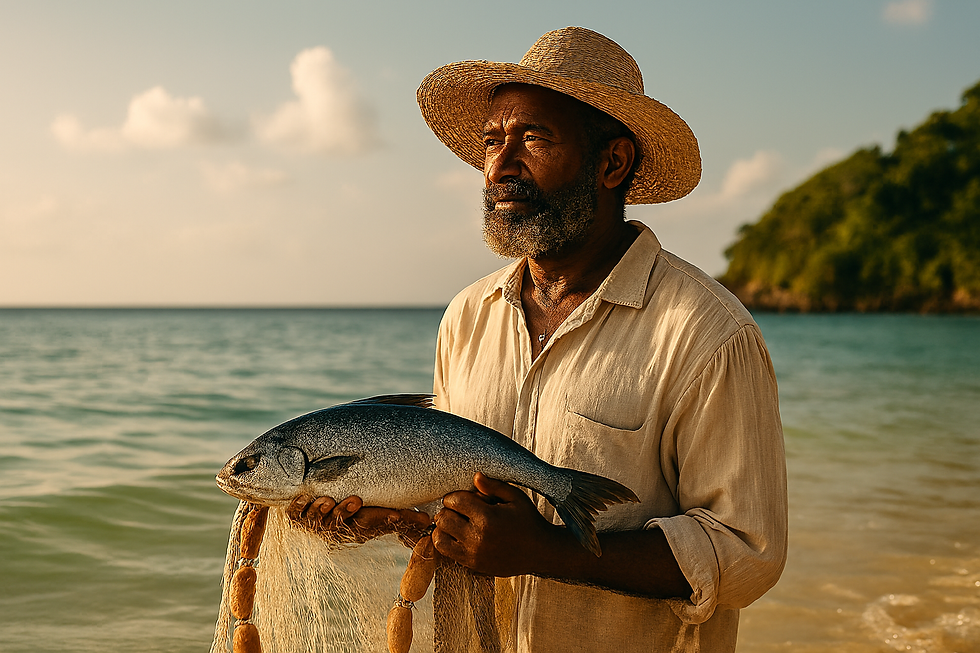
To understand Tobago’s fishers is to understand patience. They rise when darkness is still full of stars, feeling out weather changes others can’t see.
They know when the flying fish migrate, when dolphin fish are running, when it’s time to leave a reef alone so the stocks can replenish.
Sustainable fishing in Tobago is often unwritten. It is something taught in silence and example.
One fisherman explained it:
“The sea feeds you when you respect it. You can’t take everything.”
And so, small boats return to shore carrying what the sea can afford to spare.
Fishers here are frontline climate watchers, too. They see coral bleaching before it makes the news. They know when tidal currents shift. They know when something is changing in the ocean’s rhythm.
Their voices are needed in every conversation about environmental policy and food security.

The Food Artisans: Crafting With Love, Time, and Tradition
There are foods in Tobago that cannot be industrialized without losing their soul.
Cocoa sticks are made by hand in a mortar and pestle.
Coconut bake kneaded with muscle memory.
Sugar cake cooked in a pot, with measurements made by instinct.
Smoked herring and coconut choka made on a coal pot that has seasoned itself over decades.
These artisans are cultural archivists. They hold techniques that do not live in cookbooks. They are the bridge between the past and the present.
And increasingly, they are finding new ways to make these traditions viable in a modern food economy: selling at eco-markets, collaborating with restaurants, supplying small-batch ingredients to chefs who value heritage.
Their craft is survival and celebration, both.
Why These Heroes Matter Now
As global supply chains grow unstable, climate shifts reshape coastlines, and processed foods crowd out traditional diets, Tobago’s food heroes remind us of something vital:
Food is not just consumption.
Food is identity.
Food is memory.
Food is sovereignty.
By supporting local farmers, fishers, and artisans, Tobago strengthens:
- Food security
- Community resilience
- Culinary heritage
- Sustainable tourism
- Economic independence
This is not just about eating local.
It is about protecting the people who protect the land and sea that feed us.

How Tobago Can Support Them
- Buy directly from local producers.
- Feature local ingredients in events, restaurants, and community spaces.
- Document their stories and honor their knowledge.
- Advocate for fair pricing and local agricultural/fishing policy support.
- Teach children where food truly comes from.
Because the future is not built only through innovation.
Sometimes, it is shaped by remembering.

A Closing Thought
The next time you taste a dish that feels like Tobago, pause.
Think of the farmer in the early morning light.
The fisher is studying swell and wind.
The artisan stirring a pot with patience older than words.
They are the quiet architects of Tobago’s sustainable food future.
And their stories deserve to be told.


Comments